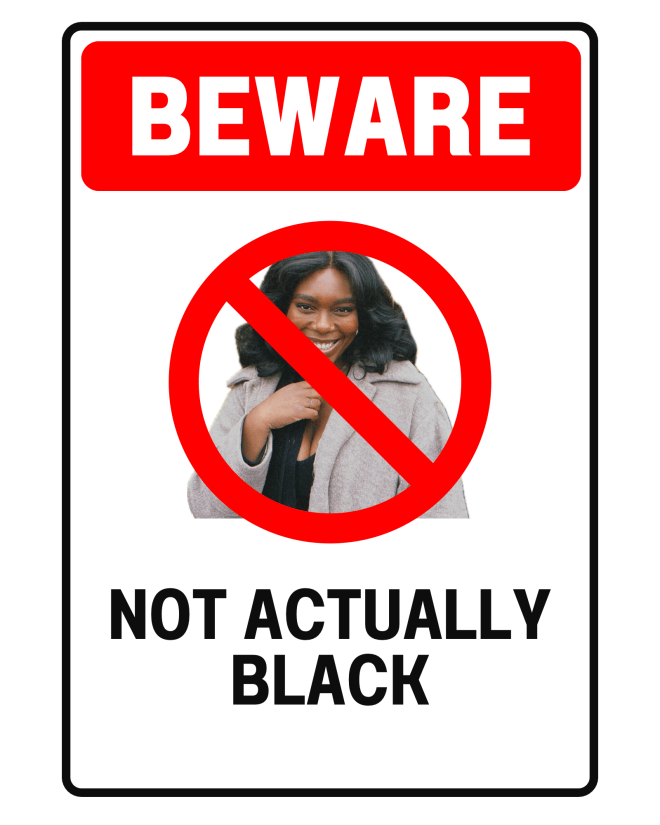
I have started writing this blog so many times in the past but today is the day. The reason behind my reluctance is because I feel like I’m stepping into territory that will undoubtedly upset some people—particularly other Black people as it goes against their reality and world-view. But this is my story. and my reality. It deserves to be heard, and it’s valid.
Growing up in the very ‘white’ Devon countryside, I was one of the only Black kids in my entire school yet I loved my school and for the most part, my experience there was overwhelmingly positive, and I’m grateful for that. School should have been the place where I felt the most different but it was not for me.
Once a year for quite a few of my teen years, I attended a Nigerian conference—a space that should have felt like home. It didn’t. Instead, it was an annual reminder that I wasn’t “Black enough” and I was too white for the black kids.
Here’s the thing: the narrative most people hear from Black individuals is the racism they’ve experienced from white people. That story is real, and it’s important. But what happens when the people who make you feel the most excluded, the most insecure in your Blackness, are Black people? That’s a story you don’t hear often enough.
Some of the most hurtful comments I’ve ever experienced haven’t come from white people. They’ve come from other Black people – the people who ‘look like me’. If those same words had been said by a white person, they’d be cancelled without hesitation. Yet, when it’s Black people saying them, somehow, it’s just a joke.
Even now, in 2024, I still find myself around Black people who make comments about me being an “Oreo” (black on the inside and white on the outside) or call me a “white girl” simply because I do not fit the (mostly negative) stereotypes of black people. Maybe to some, those comments are funny or lighthearted, but it’s damaging.
I recently came across a post that perfectly summed up this contradiction:
“When Black people display their intelligence, they are NOT imitating whiteness because intelligence is not an inherently white trait. Black excellence is real and has nothing to do with white proximity.”
That hit me deeply because it gets to the root of the problem. The idea that being polite, educated, articulate, or on time makes me less “Black” is not only untrue—it’s harmful. Why are traits like excellence and intelligence seen as betrayals of Blackness? Why does the very idea of being well-mannered or breaking stereotypes threaten people so much?
My intelligence can’t possibly come from my brilliant parents, who pushed me to be my best—especially my mum, whose mind is nothing short of extraordinary. No, it has to be because I grew up around white people. My manners? They can’t be the result of being raised by a godly mother who instilled respect and integrity in me. No, they have to be because I spent time in white spaces. Even the way I dress can’t be because my parents engrained in us to take pride in our appearance and how we present ourselves to people. No, apparently, that’s all thanks to white influence.
Everything good about me, in their eyes, gets credited to the very people they claim to resent. The same people they accuse of stereotyping and boxing us in are the ones they point to as the source of my success, as if Black excellence couldn’t possibly stand on its own.
The irony? These same Black people will post on social media about being angry at being stereotyped or placed in boxes by white people. Yet here I am, apparently not Black enough, because I don’t fit into the stereotypical “mould.” Make that make sense. What is the point of forging the way for black people to succeed in this society and stand out if the moment they do, you call them white?
What’s even sadder is that it feels like they’re not just labelling me—they’re angry about it. Angry that I don’t conform to the negative Black stereotypes they’ve internalised. It’s as though being on time, being well-mannered, well-educated, speaking proper English, and valuing grammar are somehow betrayals to my Blackness.
Here’s the truth: the world is changing. Slowly. But it hasn’t changed fast enough to make this conversation irrelevant. One day, these same Black people’s children will experience being stereotyped, boxed in, and judged. And maybe then they’ll realise how damaging it is to be told who you are—or who you aren’t—based on someone else’s narrow definitions.
So no, I don’t care if I’m “too white for the Black kids.” I am me. My Blackness doesn’t disappear because I pronounce words correctly or because I’m well-mannered. My skin colour doesn’t fade just because I refuse to shrink myself into the stereotypes you’re comfortable with. You don’t get to define me. You don’t get to tell me who I am. My Blackness is mine.
This is how I speak. This is how I write. This is who I am. I am not posh. I am not ghetto. I am El-Ruth Harmony—and trust me, it’ll do you good to remember that.
 The Harmony Edit