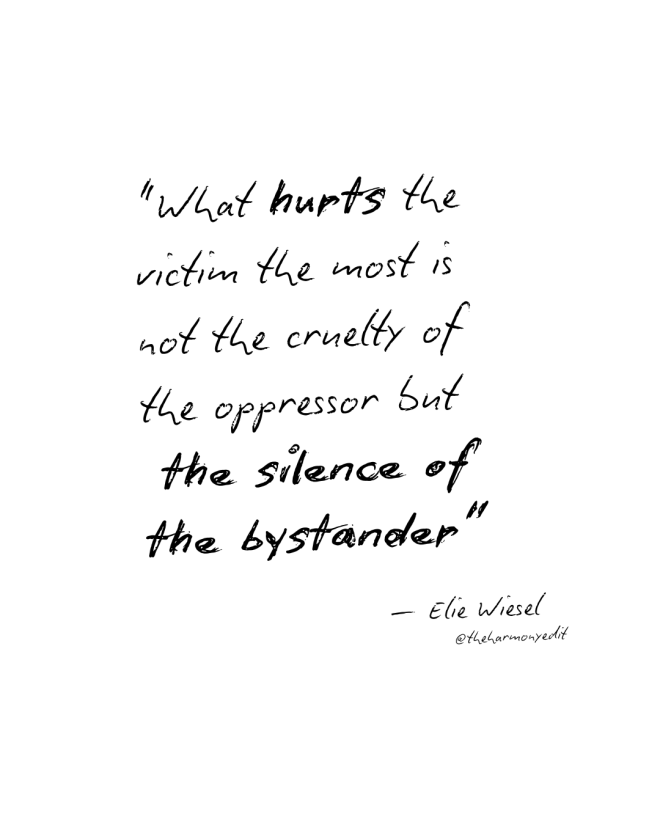
In the UK, witnessing a crime is not a crime in itself. Unless it falls under very specific exceptions, the law does not demand your involvement. It does not require you to step in. Legally speaking, silence is allowed.
Somewhere along the way, people took that legal omission and applied it to everything else in life. As if doing nothing is harmless. As if watching someone get hurt absolves you from the hurt itself.
We learn it early.
In the playground, most children are not the bully, but neither are they the friend who stands beside the child being humiliated. They watch. They walk away. They blend into the noise of “it was not me”.
It continues into adulthood.
The friend who witnesses harm done to someone they claim to love, yet still concludes, “Well, they never did anything to me personally,” as if empathy requires personal injury, as if loyalty only counts when it is convenient.
The colleague who knows gossip is spreading, character is being shredded and truth is being twisted, but decides it is safer to stay quiet than stand up for the one being torn apart. They do not wield the knife, but they hold the silence that makes the cut deeper.
The parent who knows one child is being mistreated by others in the family but prefers the appearance of harmony to the work of healing what is broken behind the scenes. It is easier to pretend the wound is not there than disrupt the illusion of a happy family.
The family friend who visits often enough to see the signs of neglect, the bruises that do not match the explanations, the fear in a child’s eyes, but chooses politeness over intervention. “It is not my place,” they say, even though silence is a place, and they have chosen it.
The partner who avoids confrontation at all costs, even when their spouse is being mistreated in front of them. They call it keeping the peace, but peace without protection is abandonment disguised as softness.
And let us not forget the churchgoers who know full well that their church is cliquey, who see the same people excluded every week, yet stay silent because they benefit from being on the inside.
This is the harm of the bystander.
The law may excuse their passivity, but the soul cannot.
Because the question that echoes in the heart of the hurting is simple and devastating:
Why does my pain not move you to action?
Am I worth so little in your eyes?
Where is your empathy?
And what is haunting is this:
A bystander is the exact opposite of Jesus.
Jesus overturned tables when He saw injustice in the Temple.
He refused to walk past wrongdoing politely.
The Good Samaritan stopped for a man he did not know, to clean up a mess he did not create, to bind wounds he did not cause.
Imagine a world where people only care about what touches them directly.
Where we justify silence with “It is not my business”.
Where we ignore what our eyes can clearly see and comfort ourselves with lies that make us feel better about doing nothing.
We do not need to imagine it.
It is the world we live in.
But I refuse to allow it to be me.
I will endeavour to be the one who got too involved.
The one who cared too much.
The one who stood up when everyone else stayed seated.
The one who spoke when silence would have been easier.
Being accused of overreacting, overcaring or overstepping is a far lighter offence to live with than the guilt of doing nothing.
I can live with being “too much”.
I cannot live with being a bystander.
Can you?
“Speak up for those who cannot speak for themselves; ensure justice for those being crushed.”
Proverbes 31:8
 The Harmony Edit